
At one of the fields of the Krasnoleninsky arch, hierarchical neural networks were tested for predicting oil saturation in reservoirs of the Vikulov Formation. The rocks occur at depths of 1,400–1,600 m. The Vikulov Formation includes the VK1 and VK2–3 intervals, which have a micro-layered lenticular architecture. In some parts of the field, the formation is complicated by deposits of an incised river valley. The seal is formed by overlying clay rocks of the Khanty-Mansiysk Formation, which act as a regional fluid seal.
The training set for the hierarchical neural-network algorithm included target oil saturation curves from 30 wells, with 7 wells used as control wells. It also included partial-stack datasets with average angles of 5°, 15°, 25°, 35°, and 45°, as well as AVO attributes. A 1D Kohonen classification algorithm with 30 nearest neighbors was used to train the hierarchical neural networks. The network architecture included 5 hidden layers with 15 neurons in each hidden layer.
The hierarchical neural networks produced a geologically consistent result and high prediction quality; for the control wells, the oil saturation correlation coefficient was 0.71.
Practical takeaway
Hierarchical neural networks can serve as a fast and efficient tool for quantitative seismic interpretation, reducing the number of computational steps, accelerating delivery of results, and lowering the risk of error accumulation compared with classical multi-stage workflows.
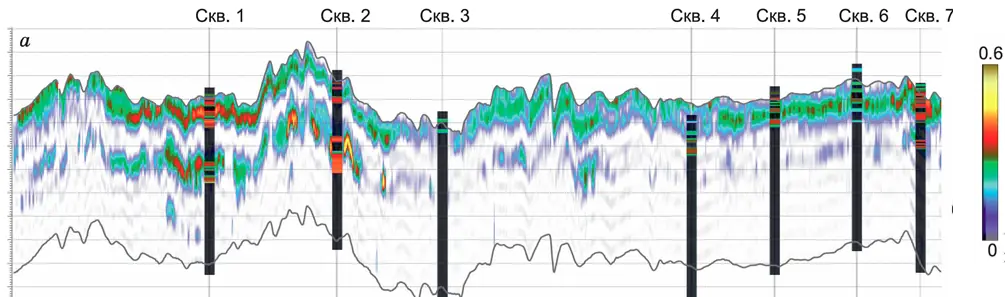
Oil saturation cube section through control wells
Comparing the oil saturation distribution along the section with control wells makes it possible to assess the areal and vertical consistency of the prediction.
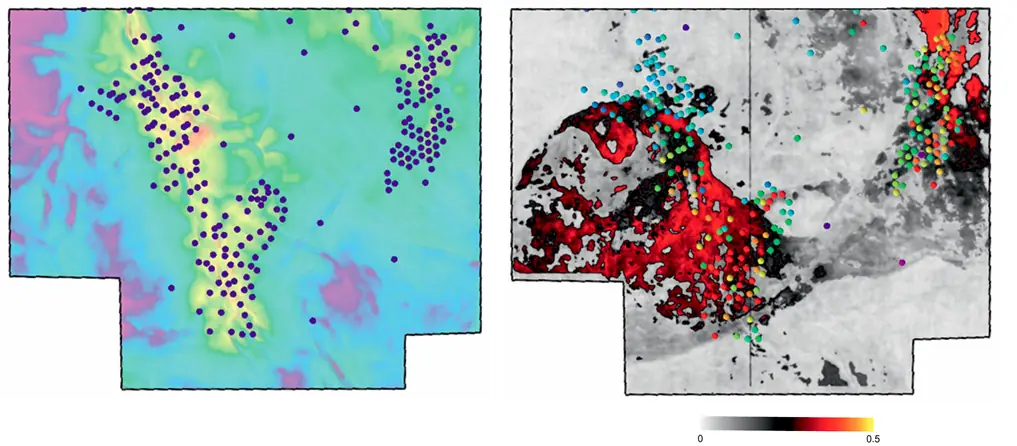
Structural map and average oil saturation map
The structural map is shown on the left, and the average oil saturation map on the right. Joint analysis helps interpret spatial prediction patterns and identify prospective zones.