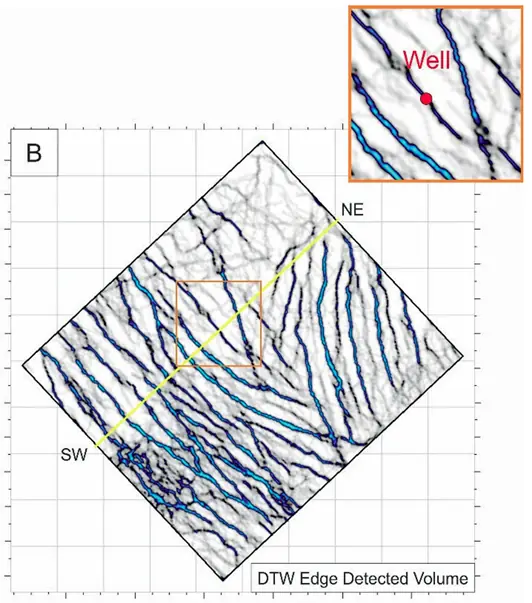
At one of the oil fields in Eastern Ciscaucasia, DTW technology was applied for high-resolution detection of faults and fractured zones from 3D seismic data. The task was to improve the detail of fault mapping in intervals with fracture-related porosity. The study used a stacked time cube with 65-fold coverage and 7 wells.
Unlike traditional multi-trace attributes based on windowed correlation, DTW performs sample-by-sample data matching, making it possible to identify discontinuities, small shifts, and subtle breaks in reflector continuity more accurately.
The key result of the work was that DTW technology made it possible to identify a fault anomaly near the control well that had not been traced using standard attributes. This anomaly was subsequently confirmed by independent data: cross-dipole acoustic logging and FMI, where subvertical fractures were observed.
Practical takeaway
DTW attributes can support decision-making in further drilling planning, geosteering of horizontal wells, and hydraulic fracturing design.
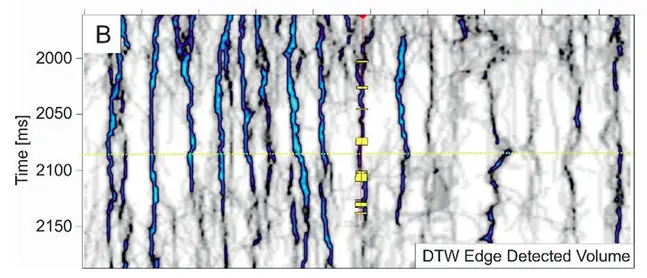
DTW attribute section
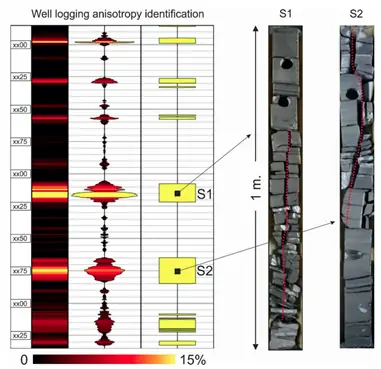
Comparison of cross-dipole acoustic log interpretation with core data.